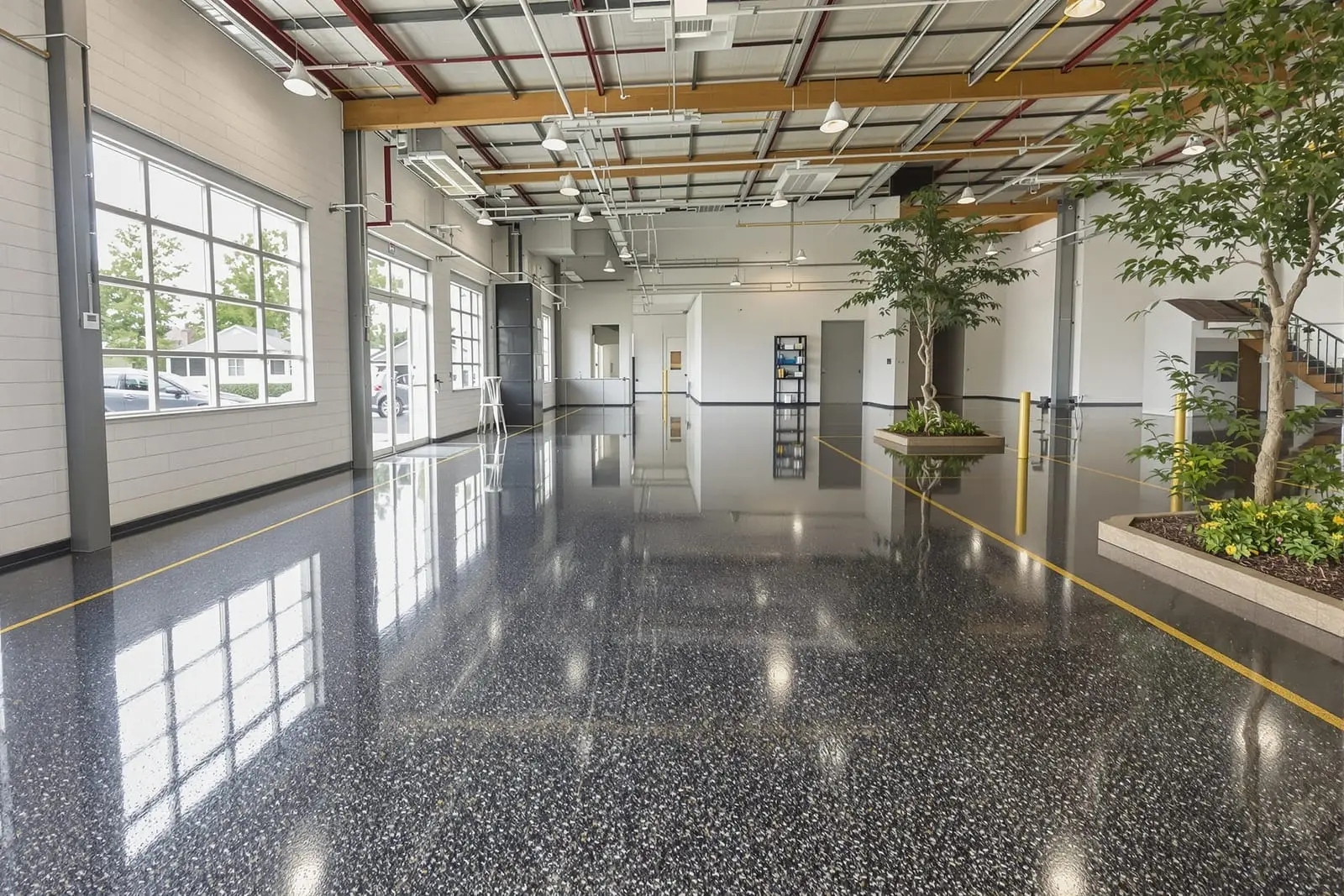
Support heavy loads with industrial concrete floors in Cincinnati, OH. We pour and finish warehouse slabs designed for forklifts, racking systems, and production equipment. Our focus is on flatness, joint layout, and reinforcement so your floor performs in demanding environments.
Primetime Concrete Cincinnati provides professional industrial concrete floors throughout Cincinnati, OH and the surrounding area. Our licensed, insured crew delivers safe, clean, on-time work with a free estimate before anything begins. Call (513) 586-6699 or request your free quote.
Industrial Concrete Floors Built For Real Cincinnati Warehouse Loads
Warehouse and industrial concrete floors in Cincinnati take a beating: heavy racking, lift trucks, point loads from machinery, and constant temperature swings from humid summers to freeze-thaw winters. Primetime Concrete Cincinnati designs each slab around your actual use, not a generic spec sheet. We look at your rack layout, forklift type and wheel loads, planned expansion joints, and whether you need flatness tolerances suitable for narrow aisle systems.
We start with the intended use. For light manufacturing or basic storage, a 6 inch slab with proper reinforcement may be appropriate. For high-bay racking, very heavy pallets, or dock areas, we may move to 7 or 8 inches with a higher strength mix and tighter joint spacing. We also account for local soil conditions and the fact that many older Cincinnati warehouses sit on fill or disturbed subgrade, which can require remediation before concrete ever shows up.
From there we select the slab type: conventional slab-on-grade with doweled joints, jointless or reduced-joint slabs with macro synthetic fibers, or heavily reinforced slabs for areas that may see future machine anchors or pits. The goal is to give you a floor that will not curl excessively, minimizes random cracking, and can actually be maintained with your equipment and staff.
How We Design and Prepare Warehouse Slabs
Good industrial concrete floors start below the concrete. Primetime Concrete Cincinnati begins with a site visit and, when needed, coordination with a geotechnical engineer. For new construction we inspect the subgrade, check compaction, and identify soft spots that would later cause slab settlement. For existing buildings we assess existing slabs, see where cracking or differential settlement has already occurred, and determine whether full replacement, partial replacement, or topping slabs make sense.
Subgrade preparation typically includes proof-rolling with loaded equipment, then compacting the base in thin lifts. We often recommend a minimum of 4 to 6 inches of compacted crushed stone base in the Cincinnati region to promote drainage and reduce frost-related movement. If groundwater or infiltration is a concern, especially near the Ohio River or in low-lying areas, we may introduce underdrains or thicker stone to keep moisture away from the slab.
Before placing concrete we install vapor barriers where appropriate, particularly under floors that will receive epoxy, urethane, or other moisture-sensitive coatings. We also detail and stake forms, set elevations using lasers, and preplan all slab panels and construction joints. This planning step prevents awkward joint locations in doorways, at rack legs, or across machine bases, which are frequent failure points in poorly planned warehouse floors.
Concrete Placement, Reinforcement, and Flatness Control
When it is time to pour, we schedule concrete placements to match Cincinnati weather patterns. In the summer we often start very early in the morning to get finishing done before peak heat and humidity, and in cold weather we use heated enclosures, insulated blankets, and adjusted mix designs so the slab cures correctly and does not freeze. Primetime Concrete Cincinnati works closely with local ready-mix suppliers to specify the right mix, typically 4000 to 5000 psi for industrial concrete floors, with controlled slump and admixtures for workability and reduced shrinkage.
Reinforcement is matched to your floor's demands. Options include welded wire fabric placed correctly on chairs (not left at the bottom of the slab), deformed rebar in grids or bands, and macro synthetic fibers to distribute shrinkage and impact loads. In heavy traffic forklift aisles and dock areas, we often combine doweled contraction joints with additional steel to resist joint spalling.
During placement we use laser screeds or advanced screed systems when project size and layout justify it. This equipment helps achieve tighter flatness (FF) and levelness (FL) numbers that matter for narrow aisle forklifts, high racks, and sensitive equipment. Our crews immediately follow with bull floating, restraightening, and timed power troweling. Overworking the surface or adding bleed water back in is avoided to reduce dusting and surface weakness later on.
Joints are saw-cut as soon as the concrete can support saws without raveling. Joint spacing is designed according to slab thickness and panel size, not just a rule of thumb, which significantly reduces uncontrolled cracking. We then seal key joints to keep out incompressibles like gravel and pallet chips that would otherwise break joint edges over time.
Surface Finishes, Coatings, and Traction Options
Industrial concrete floors are more than just structure. The surface determines how forklifts roll, how easy cleaning will be, and how safe your employees are when floors are wet. Primetime Concrete Cincinnati offers several finish options tailored to actual warehouse conditions.
For most rack and forklift areas, we provide a machine troweled hard steel finish to achieve a dense surface that resists abrasion and tire wear. Where additional durability is needed, we can apply dry shake hardeners that introduce metallic or mineral aggregates at the surface. This is particularly useful in high-traffic loading docks and staging zones where pallets are dragged or dropped.
If you require chemical resistance or specific colors for safety zones, we coordinate with coating installers to ensure the slab is finished, cured, and tested for moisture in a way that supports epoxy or urethane systems. Many Cincinnati facilities struggle with high slab moisture due to local groundwater and humidity. To avoid coating failures, we test vapor emission rates and can recommend mitigation such as moisture-tolerant primers or longer cure times before coating.
For cold storage, wash-down areas, or facilities with oils and liquids, we modify the finish to balance cleanability with slip resistance. Options include light broom finishes, textured trowel patterns, or broadcast aggregates in clear sealers in defined walkways or hazard zones. We also plan floor flatness with your actual equipment in mind so you do not end up with water ponding in traffic aisles or in front of dock doors.
Repairs, Replacement, and Working Around Active Operations
Many Cincinnati warehouses and industrial buildings already have problematic floors. Primetime Concrete Cincinnati routinely repairs joint spalls, curled panels, heaved slabs near exterior doors, and cracked or settled areas around columns and dock levelers. We start with root-cause diagnosis so you are not paying to patch symptoms that will return.
Common fixes include sawcutting and removing failed slab strips along joints, then re-pouring with dowels that tie new concrete to old while allowing movement. For settled panels we may use slab stabilization grouts or foam lifting if the subgrade is competent, or full-depth replacement if the base has failed. At dock areas that frost heave in Cincinnati winters, we often address drainage and insulation outside the building along with the slab work.
If your facility is operating 2 or 3 shifts, shutdown time is critical. We phase work so aisles remain open, schedule demolition and pours around your shipping windows, and use high-early-strength mixes where required so forklifts can return to service sooner. We also coordinate dust control and temporary protection so your inventory and equipment are not contaminated by concrete dust or debris.
For older buildings that need a new surface but cannot lose slab thickness, we can sometimes grind and polish the existing concrete, or install bonded toppings with carefully prepared substrates. Each option has structural and budget implications, which we explain in detail before you decide.
Cost, Scheduling, and What Cincinnati Owners Should Decide Upfront
Cost for industrial concrete floors is driven by more than square footage. Primetime Concrete Cincinnati walks you through each factor that affects price so you can align scope with your budget. Slab thickness, reinforcement type, flatness requirements, use of laser screeds, dry shake hardeners, and coatings all move the number up or down. Subgrade issues like undercutting poor soils, adding more stone, or installing drains can be significant but are crucial to avoiding expensive slab failures later.
Local seasonal timing also matters. In Cincinnati, late spring through early fall is prime for large slab placements, but high humidity and rapid temperature swings can affect cure and finishing. Winter pours are entirely possible but may require heating, blankets, and cold weather admixtures, which adds cost. We help you decide whether to accelerate work into a season or phase the project to balance performance and budget.
Before hiring any concrete contractor, industrial property owners should decide on a few key items: expected life of the facility, potential future reconfigurations of rack or machinery, planned floor coatings or polishing, and acceptable downtime. Clear answers allow us to design for future sawcutting, embeds, or conduit runs without compromising slab performance.
When you contact Primetime Concrete Cincinnati, we typically start with a walkthrough of your warehouse or site, a review of any engineering or architectural drawings, and a discussion of your operational requirements. From there we provide a written scope, layout plan, and schedule proposal so you know exactly what will happen, in what sequence, and how it will affect your operations.
“
Professional warehouse & industrial concrete floors, done right the first time, quality materials, honest pricing, and results that last.
Primetime Concrete Cincinnati
Warehouse & Industrial Concrete Floors Across Our Service Area