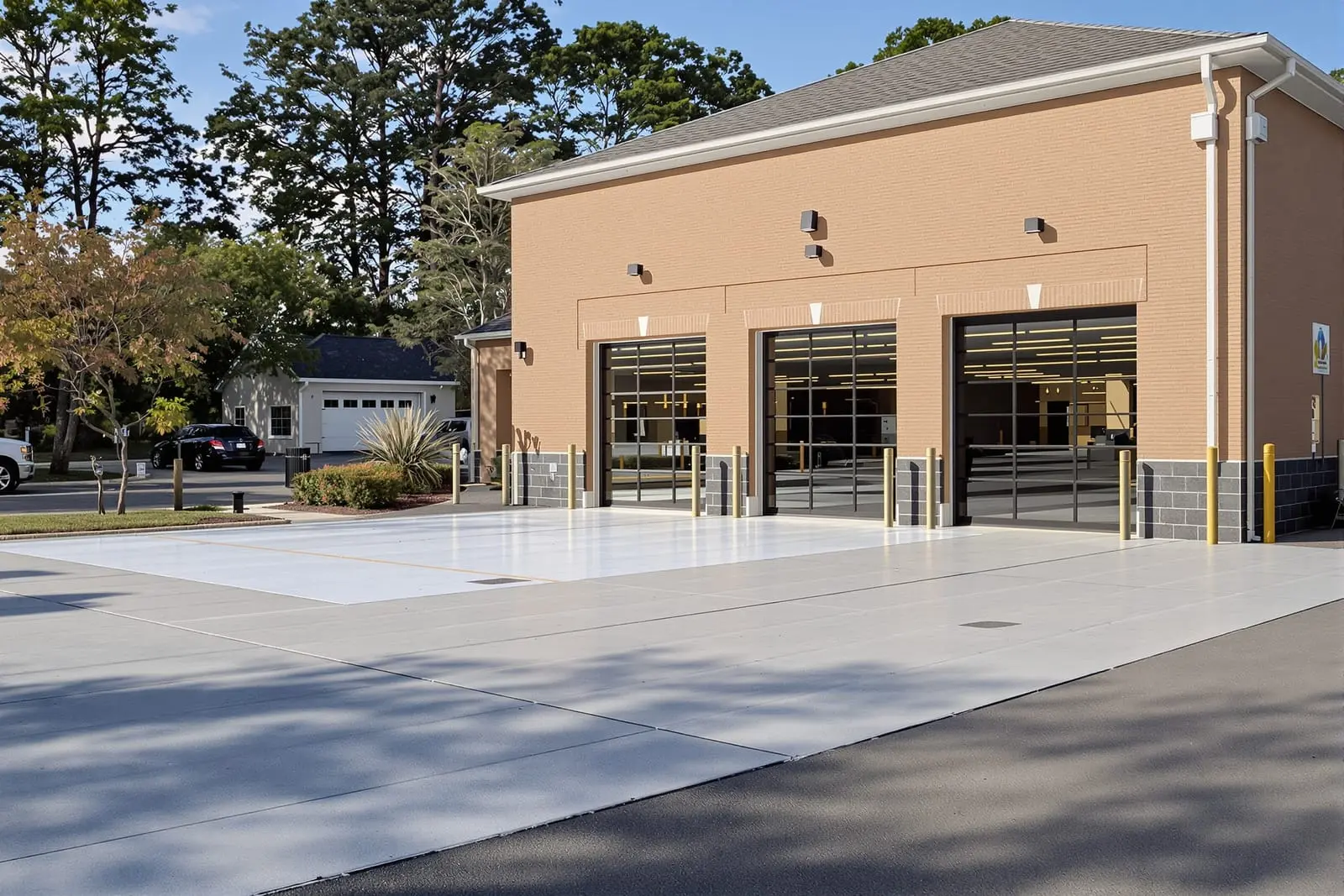
Support truck traffic and equipment with a commercial concrete slab in Cincinnati, OH built for heavy duty use. We pour loading dock aprons, dumpster pads, and equipment slabs with proper thickness and reinforcement. Our slabs withstand frequent loading, point loads, and exposure to the elements.
Primetime Concrete Cincinnati provides professional commercial concrete slab throughout Cincinnati, OH and the surrounding area. Our licensed, insured crew delivers safe, clean, on-time work with a free estimate before anything begins. Call (513) 586-6699 or request your free quote.
Commercial concrete slabs and loading docks built for Cincinnati conditions
Primetime Concrete Cincinnati designs and installs commercial concrete slabs and loading docks that are sized, reinforced, and placed for the real loads your operation sees every day. Whether you run a small warehouse in Queensgate or a distribution center near I-75, we focus on traffic patterns, forklift weights, trailer heights, and freeze-thaw cycles specific to the Cincinnati region.
A commercial concrete slab is not a bigger version of a residential driveway. It has to support concentrated rack loads, point loads from dock levelers and scissor lifts, and repetitive impact from pallet jacks and forklifts. We start every project with a site visit, field measurements, and a review of how you actually use the space. That allows us to select slab thickness, reinforcement, and joint layout that fit both your current operation and your plans for expansion.
From older industrial buildings in Norwood that need upgraded loading areas to new tilt-up warehouses in Sharonville, our team understands local soil conditions, drainage patterns, and city requirements. The goal is a slab and dock that perform quietly in the background, without settlement, spalling, or shutdowns for constant patching.
Planning your loading dock or slab: traffic, loads, and layout
Before we talk about concrete mix or rebar, Primetime Concrete Cincinnati maps out how vehicles and equipment move on your site. We look at questions like: Are you handling 53-foot trailers, box trucks, or Sprinter vans. Do forklifts cross slab joints all day in the same wheel paths. Where do snow piles and meltwater usually sit in winter. These details drive design choices that directly affect performance and long-term cost.
For loading docks, we measure trailer heights and recommend dock height, approach slope, and, if needed, the use of concrete aprons or trench drains to keep water away from the building. In older Cincinnati facilities where dock heights do not match today’s trucks, we discuss partial demolition and re-pour options that correct unusable slopes and standing water problems.
For interior and exterior commercial concrete slabs, we map racking locations, column lines, and machinery pads. This lets us avoid saw cuts under rack posts, thicken concrete where pallet racks sit, and plan reinforcement so joints do not fall under high traffic areas. By handling this planning up front, you reduce slab cracking, corner breaks at joints, and trip hazards for your crew.
How we build commercial concrete slabs that last
A typical commercial concrete slab project in Cincinnati starts with excavation and subgrade preparation. We remove unsuitable fill, old broken concrete, and organic material, then compact the subgrade with plate compactors or rollers, checking density so the slab does not settle later. On many local commercial sites, especially along the river or in older industrial yards, we encounter variable fill. When that happens, we stabilize soft areas with additional stone, geotextile fabric, or both.
Next, we install a graded base, usually 4 to 8 inches of compacted crushed stone, to provide drainage and uniform support. Vapor barriers are added when interior slabs support offices, conditioned warehouses, or food storage where moisture migration could damage flooring or inventory.
Reinforcement depends on the slab purpose. For heavy forklift traffic or dock areas, we often use a combination of rebar in key locations, wire mesh, and sometimes dowel baskets at joints to transfer load between panels. We set and tie reinforcement so it stays in the middle of the slab during the pour, instead of sinking to the bottom where it does little good.
During placement, our crew uses laser levels and screeds to achieve consistent thickness, then bull floats and power trowels to finish the surface. For loading dock aprons and exterior work, we usually recommend a broom or textured finish to improve traction in wet or icy conditions. For interior slabs, finishes can range from hard-troweled to densified and polished depending on your maintenance plan and safety requirements.
Finally, we cut control joints at planned locations and depths to direct natural shrinkage cracking. Proper joint spacing, timing, and layout are critical, especially in Cincinnati’s climate where temperature swings are significant. We also apply curing compounds or wet curing methods so the concrete reaches full strength and resists surface dusting.
Design options for different businesses and industries
Not every commercial concrete slab should look or perform the same way. Primetime Concrete Cincinnati tailors designs so you do not overpay for a slab that is more than you need, or underbuild a slab that fails early.
Warehouses and distribution centers often need thicker slabs with high load transfer capacity and tight joint layouts to handle high-cycle forklift traffic. In these spaces, we may recommend doweled joints, joint fillers that stand up to wheels, and surface hardeners in travel lanes.
Manufacturing shops in places like Blue Ash or Fairfield might need isolated machine pads thickened beneath CNC machines, presses, or mixers. We can thicken the concrete locally and add extra reinforcement or anchor bolts so the equipment sits level and vibration is controlled.
Retail back-of-house or restaurant loading areas, especially in tighter Cincinnati neighborhoods, typically require careful attention to drainage and pedestrian safety. In those cases we can incorporate gentle slopes away from doors, non-slip broom finishes, and clearly defined transition areas between vehicle paths and walkways.
For exterior commercial slabs that double as parking or staging, we look at deicer exposure, plowing methods, and shading from nearby buildings. We recommend mixes and air entrainment suited to repeated freeze-thaw cycles and deicing salts commonly used by local plow contractors.
What affects cost on a commercial concrete slab project
Business owners often ask why one commercial concrete slab quote looks different from another. Primetime Concrete Cincinnati is transparent about the main cost drivers so you can compare bids fairly and choose the right scope.
Key factors include slab thickness, reinforcement type and amount, concrete strength, and access for trucks and equipment. A 6 inch slab for light pallet jacks is very different from a 10 inch heavily reinforced loading dock apron designed for constant semi traffic. The concrete mix design, including air content and strength rating, also affects price and performance.
Subgrade and base preparation can be a major variable, especially on older Cincinnati industrial properties where we frequently find buried debris or poorly compacted fill. Bringing those areas up to standard requires extra excavation, stone, and compaction but it prevents settlement and slab failure later.
Site logistics matter as well. Limited access behind tight buildings in downtown or Over-the-Rhine may require smaller trucks, pumping concrete, or phased pours, all of which affect labor and equipment costs. Working around ongoing operations (staggered shifts, night or weekend work) can also influence price, and we factor that in during planning so there are no surprises.
We walk you through these elements at the estimate stage, explaining where you can save and where cutting corners would cause problems. Our goal is to match slab performance to your actual needs and budget, not just provide the cheapest short-term number.
Common loading dock and slab problems we solve
Cincinnati businesses frequently call us after they start seeing problems with existing loading docks and slabs. Typical issues include slab settlement at dock doors that creates a lip between the dock and the trailer, cracked or broken joints where forklifts travel, and ponding water that turns into ice in winter.
Primetime Concrete Cincinnati evaluates whether repair or replacement is the better option. In some cases, joint rebuilding, selective slab replacement, or dowel installation can restore performance. In others, especially where the base or subgrade has failed, a full-depth replacement is more cost effective over time.
We also see many older docks where slopes are too steep or drainage runs toward the building. In those situations we may re-grade the approach, install trench drains, and re-pour the surface with corrected elevations. For interior slabs that show random cracking or surface dusting, we trace the cause, which could be poor curing, inadequate joint layout, or moisture. Then we recommend solutions such as joint cutting and sealing, surface densifiers, or if required, new sections of slab.
By focusing on root causes instead of patching the visible symptom, we help you avoid repeated shutdowns and maintenance calls that interrupt your operation.
What to expect when you work with Primetime Concrete Cincinnati
From the first walkthrough to final cleanup, our commercial process is built around minimizing disruption to your operation. We start with a consultation on-site, listening to how your docks and floors need to function, not just measuring square footage. We coordinate schedules so pours happen during low-traffic hours when possible and clearly mark off work zones to keep your staff and visitors safe.
Before work begins, you receive a written scope explaining slab thickness, reinforcement, joint layout, and access plans so your team knows exactly what is being installed. During construction, a supervisor is on-site to manage concrete delivery timing, finishing, and curing so the slab reaches its designed strength. We provide realistic timelines for when you can walk, drive light vehicles, and finally run full forklift or truck loads on the new concrete.
Primetime Concrete Cincinnati is locally based, so if you ever have a question or need adjustments, you are not chasing a contractor from out of town. We stand behind our work and want your loading docks and commercial concrete slabs to be one part of your Cincinnati facility you never have to worry about again.
“
Professional loading docks & commercial slabs, done right the first time, quality materials, honest pricing, and results that last.
Primetime Concrete Cincinnati
Loading Docks & Commercial Slabs Across Our Service Area