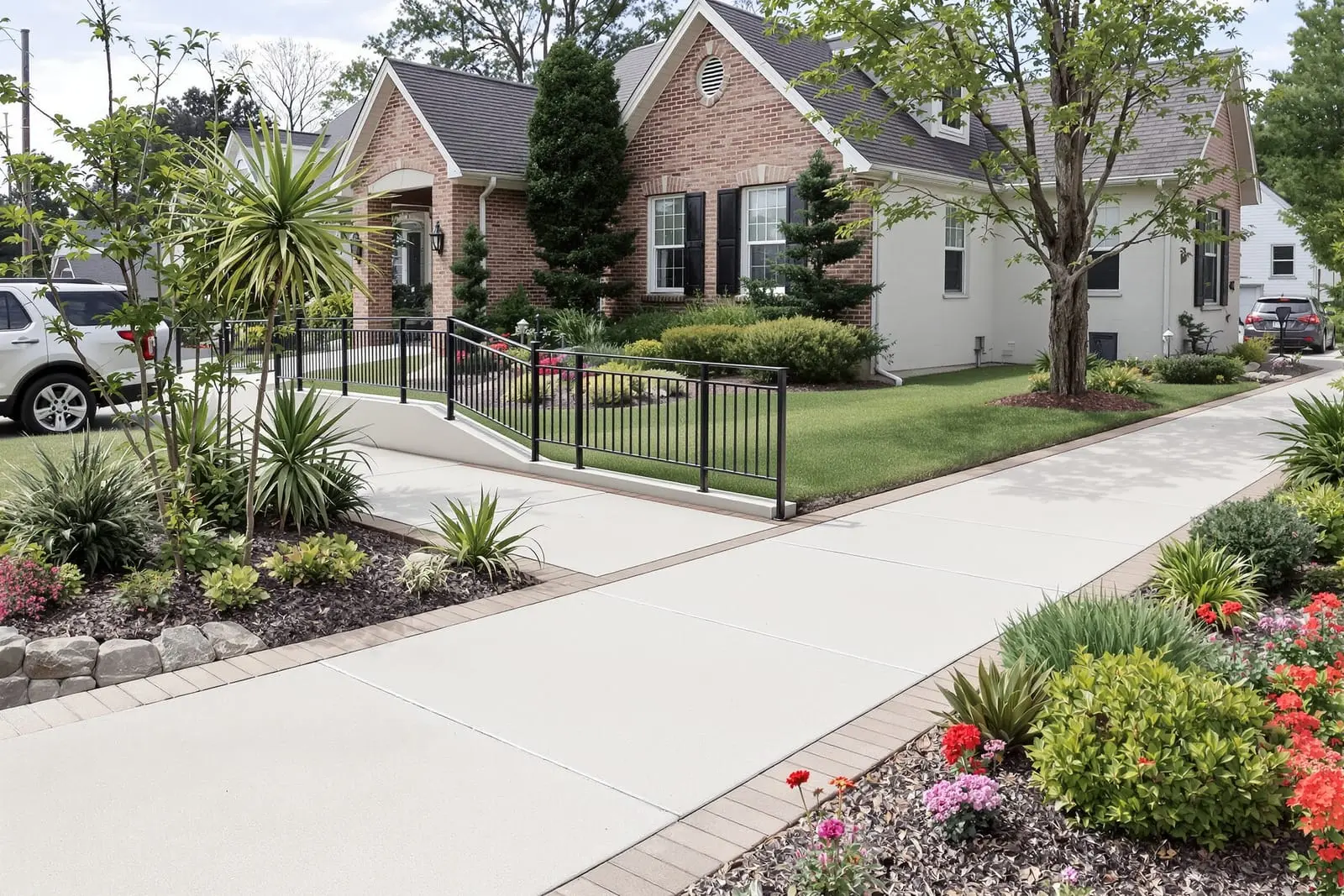
Improve access with commercial sidewalk installation in Cincinnati, OH. We build walkways, ADA compliant ramps, and entry pads that meet slope and width requirements. Our team ensures smooth transitions, detectable warnings, and durable finishes so customers and staff can move safely around your property.
Primetime Concrete Cincinnati provides professional commercial sidewalk installation throughout Cincinnati, OH and the surrounding area. Our licensed, insured crew delivers safe, clean, on-time work with a free estimate before anything begins. Call (513) 586-6699 or request your free quote.
Commercial Sidewalk Installation & ADA Ramps in Cincinnati
Primetime Concrete Cincinnati installs commercial sidewalks and ADA-compliant ramps for properties across the Greater Cincinnati area, including municipal sites, retail centers, medical facilities, schools, and industrial parks. We focus on concrete that meets local codes, handles high foot traffic, and survives our freeze-thaw cycles without becoming a maintenance problem.
For commercial sidewalk installation, we start by reviewing your site layout, traffic patterns, and how delivery trucks, carts, and pedestrians actually move through the property. This determines sidewalk width, thickness, and where ramps and detectable warning surfaces must be placed to satisfy ADA guidelines and local Cincinnati ordinances. We look at drainage, snow plow routes, and how water currently flows so the new work does not create icing or ponding.
Our team uses 4,000 to 4,500 psi concrete mixes with air entrainment suited to Cincinnati winters. In high abuse areas such as loading zones or around dumpsters, we often specify thicker slabs and heavier reinforcement. For schools, medical offices, and senior housing we pay particular attention to ramp slopes, landings, and transitions so wheelchairs and walkers can cross joints smoothly without jarring bumps.
Planning, Codes, and ADA Compliance Specific to Cincinnati
Before any concrete is poured, Primetime Concrete Cincinnati checks local code requirements, zoning, and right-of-way rules. In Cincinnati, commercial sidewalks tied into the public walk or near the curb often require compliance with city standards for thickness, base preparation, and joint layout. If your project touches a city sidewalk or curb cut, we coordinate our work with municipal specifications rather than guessing and hoping it passes inspection.
For ADA ramps, we design around the 1:12 maximum running slope and 1:48 maximum cross slope, then verify that those numbers still hold true during layout and after forms are set. We include level landings, proper ramp widths, and side flares where pedestrians step off sidewalks into parking lots. At drive entrances and at intersections, we locate and size curb ramps so they line up with crosswalks and do not direct wheelchairs into traffic.
Detectable warning surfaces (truncated domes) are installed where ramps intersect vehicular ways. We specify materials and colors that satisfy conspicuity requirements without becoming slick in winter. In Cincinnati, inspections often focus on ramp slopes, landing sizes, and warning surface placement, so we check these items with digital levels and tape measures before calling for any inspection or final walkthrough.
How We Actually Build Commercial Sidewalks and Ramps
Good commercial sidewalk installation starts with subgrade preparation. We strip organic material, soft topsoil, and loose fill until we reach firm, compactable material. Typically, we install a 4 to 6 inch base of compacted crushed limestone, which is readily available from local quarries around Cincinnati. This base prevents heaving and settlement that cause trip hazards.
Forms are then set to grade using string lines and lasers. For sidewalks and ramps, elevations are carefully set to maintain ADA-compliant slopes and to make sure water drains toward appropriate storm structures, not toward building entrances. We build forms with full-depth support so they do not bow when concrete is placed, which helps keep joints straight and edges clean.
We place welded wire mesh or rebar where needed, especially across drive aprons, dumpster pads, or areas where light vehicles cross the walk. For many retail sites, 4 inch sidewalks with mesh are standard, while 6 inch concrete with rebar is common in drive crossings and high load points. Concrete is ordered from local batch plants with an appropriate slump for finishing, plus air entrainment and proper admixtures for work in hot or cold conditions.
After placement, we strike off, bull float, and edge the slab, then install control joints at the right spacing to manage shrinkage cracking. For 4 inch sidewalks, joints are usually cut at 4 to 5 feet on center, but we adjust based on panel size and site geometry. For ADA ramps, we pay attention to where joints fall so they do not create uncomfortable bumps at the bottom of slopes. Once the concrete sets to the right firmness, we apply a broom finish perpendicular to the main walking direction for traction.
Finishes, Options, and Long-Term Durability
Primetime Concrete Cincinnati offers several finish and design options for commercial sidewalks and ADA ramps. The standard is a medium broom finish that meets slip resistance expectations in wet or icy conditions. On steep ramps or at building entrances, we may use a slightly more aggressive broom pattern for extra grip without making the surface difficult to clean.
For sites where branding or aesthetics matter, such as office parks or mixed-use developments, we can integrate decorative borders, exposed aggregate strips, or colored concrete bands while keeping the main walking surface practical and easy to maintain. We make sure any decorative choices still comply with ADA guidelines and do not create abrupt changes in level or slick surfaces.
In Cincinnati, deicing practices will strongly influence longevity. We recommend magnesium chloride or calcium magnesium acetate rather than rock salt for new sidewalks and ramps, especially during the first winter. Excessive rock salt and repeated freeze-thaw cycles can scale the surface over time. We also strongly suggest applying a penetrating concrete sealer after the first cure period and renewing it on a regular schedule. This reduces water and salt penetration, helps with winter cleanup, and stretches the service life of your investment.
Joint maintenance is another factor. Over years of use, joint sealant can wear out or pop loose. Replacing joint material and monitoring any settlement or cracking is far cheaper than waiting until sections have to be removed and replaced to eliminate trip hazards or code issues.
Cost Drivers, Scheduling, and Working Around Your Operations
The cost of commercial sidewalk installation and ADA ramp construction in Cincinnati depends on several specific factors. The most important are total square footage, slab thickness, reinforcement type, and difficulty of access. Tight job sites that require smaller equipment or hand placement will cost more than open sites a concrete truck can back right up to. Ramps with complex grade changes, retaining edges, or multiple landings involve more forming, which affects labor.
Preparation is also a major cost driver. Removing thick existing concrete, correcting drainage problems, or excavating and replacing unstable soil takes time and equipment. On older Cincinnati properties, we often encounter buried debris or shallow utilities that must be addressed or relocated. We discuss these possibilities up front and include allowances or contingency plans where appropriate, instead of surprising you mid-project.
In this region, the best time for major sidewalk and ramp work is typically late spring through early fall, when temperatures allow reliable curing. We can work outside that window, but cold weather placement may require heated enclosures, blankets, or accelerators, which adds cost. For busy commercial sites, we commonly phase work so sections remain open while others are under construction. This can involve night or off-hour pours, temporary pedestrian routes, and clear signage so customers and employees still have safe building access.
Primetime Concrete Cincinnati coordinates with your property manager, facility staff, or general contractor to sequence demolition, forming, inspection, and pouring around deliveries, peak customer times, and scheduled events. Our goal is to keep your site safe and functional while the upgrades are completed.
What Cincinnati Property Owners Should Check Before Hiring
Before you commit to any contractor for commercial sidewalks and ADA ramps, ask specific questions about local experience. They should be able to describe recent Cincinnati-area projects that passed inspection and remained trouble free after several winters. Primetime Concrete Cincinnati encourages you to look at our completed work during a rainy day or after a freeze-thaw swing so you can see how the slabs drain and how joints have held up.
Make sure your contractor provides a clear drawing or layout that shows sidewalk widths, ramp locations, slopes, landings, and any required detectable warning areas. Vague proposals lead to field improvising, which is how non-compliant ramps end up being redone. We provide written scope details, including thickness, reinforcement, and finish type, so you know exactly what you are paying for.
Ask about inspection and testing. On larger commercial jobs, it is reasonable to require that the concrete ticket information be saved and that occasional cylinder tests or air content checks be performed. Even on small projects, the crew should know how to verify slump and adjust finishing methods when temperature or wind changes during the pour.
Finally, discuss long-term maintenance expectations. A contractor who cares about performance will talk about sealing schedules, snow removal methods, and what to watch for in the first few seasons. Our team explains future repair options, from simple crack sealing to partial panel replacement, so facility managers can budget realistically instead of being surprised by emergency fixes later.
“
Professional commercial sidewalks & ada ramps, done right the first time, quality materials, honest pricing, and results that last.
Primetime Concrete Cincinnati
Commercial Sidewalks & ADA Ramps Across Our Service Area