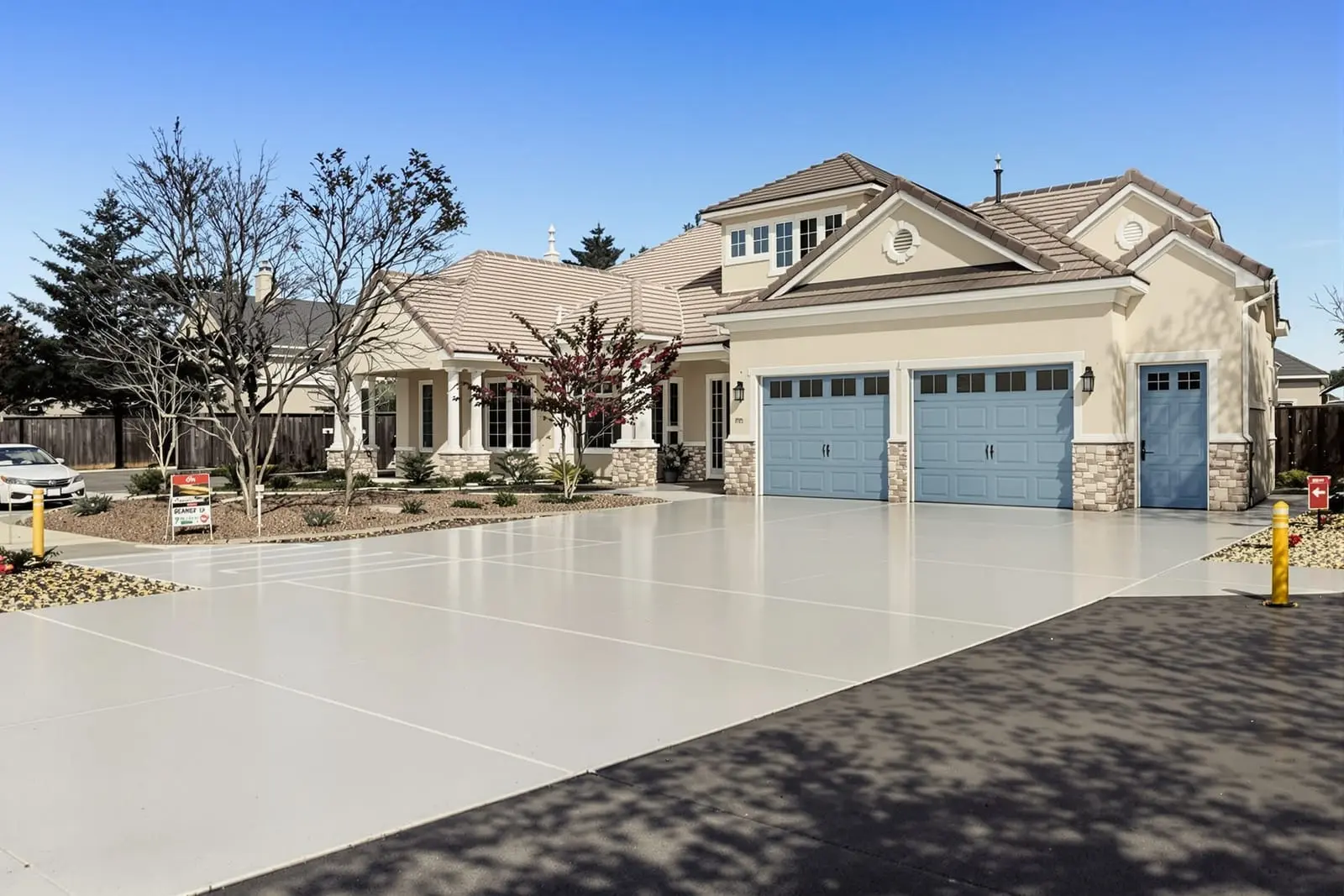
Keep your property accessible with commercial concrete paving in Cincinnati, OH. We install drive lanes, parking areas, dumpster pads, and site concrete built for heavy use. Our team coordinates around business operations to deliver flatwork that looks professional and performs under constant traffic.
Primetime Concrete Cincinnati provides professional commercial concrete paving throughout Cincinnati, OH and the surrounding area. Our licensed, insured crew delivers safe, clean, on-time work with a free estimate before anything begins. Call (513) 586-6699 or request your free quote.
Commercial Concrete Paving for Cincinnati Businesses
Commercial concrete paving is not just about pouring a slab and leaving. For Cincinnati properties, it has to stand up to freeze-thaw cycles, salt from winter de-icing, and heavy delivery traffic. At Primetime Concrete Cincinnati, we design each project around how your site is actually used, so your pavement works for your business and not the other way around.
We handle a wide range of commercial concrete paving projects: loading docks, retail parking lots, restaurant drive lanes, apartment and condo lots, truck turnaround areas, dumpster pads, walkways, and small private streets. If you are in or around Cincinnati, you have likely parked on or driven across concrete that has the same mix designs and reinforcement details we recommend for local conditions.
Instead of selling a one-size-fits-all “4 inches of concrete,” we look at expected traffic, soil conditions, drainage, and how you plan to grow. For example, a medical office with mostly passenger cars can often use a thinner section than a facility that expects daily box truck or semi traffic. Talking through those real-world details up front is how Primetime Concrete Cincinnati helps you avoid premature cracking, rutting, and expensive tear-outs a few winters from now.
How Our Commercial Concrete Paving Process Works
A typical commercial concrete paving job in Cincinnati starts with a site evaluation. We walk the property with you, look at current pavement performance, spot drainage issues, and note any utilities that need to be protected. If there is existing asphalt or concrete, we decide with you whether to mill, remove entirely, or overlay, based on its condition and your budget.
Next is subgrade preparation. The soil under your pavement is as important as the concrete itself. We strip soft topsoil, proof-roll the subgrade with equipment to identify weak areas, then undercut and replace unsuitable material where needed. On many local sites, we install a compacted aggregate base, often 4 to 8 inches of crushed stone, to create a stable, well-drained platform.
Forming and layout come after the base is compacted. We set forms to the right slope for drainage toward catch basins or swales, which is essential in Cincinnati where heavy rains can quickly expose a bad slope design. If the project needs curbs, dumpster pads, or thicker drive lanes, we stake those elevations out separately so transitions feel smooth to drivers.
Before the pour, we place reinforcement as needed. For lighter-duty lots, this might be fiber-reinforced concrete. For drive lanes, dumpster pads, or loading areas, we often use welded wire mesh or rebar on chairs to keep it in the correct position in the slab. Correct reinforcement placement is a key difference between paving that lasts and paving that spalls and cracks early.
During the pour, we use a concrete mix design tailored for commercial use, usually 4,000 psi or higher, with air entrainment for freeze-thaw durability and additives chosen for the season. In summer we might use a retarder to slow set time. In cooler weather we may use an accelerator and blankets to protect new pavement from overnight temperatures. We strike off, bull float, and finish the surface to the texture you need, often a broom finish for traction in wet and icy months.
Thickness, Joints, and Finishes That Make a Difference
The thickness and joint layout of your commercial concrete paving matter just as much as the strength of the concrete mix. For many Cincinnati car-only parking lots, a 5 inch slab is a common starting point. Areas with heavier truck traffic might go up to 6 or 7 inches, and dumpster pads and loading zones can be thicker still. Choosing the right thickness helps avoid panel rocking, corner breaks, and settlement that leads to liability issues.
Control joints are cut to manage where the pavement cracks as it naturally shrinks and moves. Primetime Concrete Cincinnati plans joint spacing according to slab thickness and panel shape. For example, on a 5 inch slab, joints might typically be about 10 feet apart, depending on layout. We saw-cut joints at the right depth shortly after the pour is set enough to walk on, which can be a narrow window in summer. Doing this on time is crucial to preventing random cracks from forming instead.
We also talk through finish options based on how the space is used. A standard broom finish is usually the safest and most cost-effective for parking lots and drive lanes because it offers good traction in rain and snow. For storefront sidewalks, we might combine broomed main paths with a light decorative border or saw-cut pattern to match existing design. In many Cincinnati retail centers, owners choose a slightly heavier broom in drive lanes to give drivers more grip in icy weather.
Edges, curbs, and transitions are part of the finish too. Rounded or tooled edges help reduce chipping where tires and plows hit the pavement. At handicap parking spaces and crosswalks, we follow ADA slope and texture guidelines, including truncated dome mats where required. These details avoid compliance issues during inspections and create a smoother experience for your customers.
What Affects Cost and Long-Term Performance
Commercial concrete paving cost in Cincinnati is driven by more than square footage. The thickness of the slab, strength of concrete, amount of reinforcement, subgrade corrections, and drainage improvements all matter. A flat, well-draining site with minimal demo will be less expensive per square foot than a tight, sloped site with failing asphalt that needs full-depth removal and base replacement.
Subgrade problems are one of the biggest hidden cost drivers. Many local properties along the Ohio River and older fill areas have soft or inconsistent soils. If we discover pumping or rutting during proof-rolling, we might recommend undercutting and replacing poor soil with compacted stone. This adds cost up front but is often the difference between pavement that lasts decades and pavement that fails in a few winters.
Weather timing is another factor. Pouring commercial concrete paving in late fall or early spring may require cold-weather measures like insulated blankets, heaters, or accelerators. Summer work sometimes needs extra crew time or admixtures to control set time and surface curing. Primetime Concrete Cincinnati discusses these impacts ahead of time so you can make informed schedule decisions.
Long-term performance also depends on maintenance. We recommend a joint and crack sealing program after the concrete has had time to cure and move through at least one season. Sealing joints helps keep water and de-icing salts out of the base layer, which is especially important in Cincinnati’s freeze-thaw cycles. If heavy trucks use your lot, periodic inspections to catch joint spalling or corner breaks early can help you plan small repairs rather than full reconstructions.
Salt and snow removal practices affect lifespan too. We can coordinate with your snow contractor to review plow blade types, plow shoe settings, and chemical choices. Certain aggressive de-icers can be harder on fresh concrete, so we will give you specific timeframes and recommendations for the first winter after paving.
Planning Your Project With Primetime Concrete Cincinnati
Because commercial concrete paving usually has to happen while a business is still operating, careful planning is part of our service. We help you phase work so customer access, deliveries, and emergency routes remain open. For example, a large parking lot might be divided into two or three phases, with clear temporary striping or signage so visitors are not confused.
Before work begins, Primetime Concrete Cincinnati can coordinate with your property manager, tenants, or facilities team to set a schedule, communicate closure areas, and confirm any special needs like early morning or weekend pours. On multi-tenant retail centers in the Cincinnati area, we often pour before store hours to reduce impact and give new pavement time to set before traffic returns.
Permits and inspections are another piece we can help with. Depending on your location and whether you are changing drainage or access points, you may need approvals from the City of Cincinnati, Hamilton County, or nearby municipalities like Norwood or Blue Ash. We are familiar with local requirements related to thickness, curb cuts, and ADA parking layouts, and can work with your engineer or architect if the project requires stamped drawings.
If you already have pavement that is failing, we will be honest about whether repair or full replacement makes better sense. Some Cincinnati properties come to us after multiple patch jobs that never last. In those cases, we explain what is happening in the base or subgrade and outline both short-term and long-term options, including phased replacements to spread out cost.
When you are ready to talk details, Primetime Concrete Cincinnati will walk the site, listen to how your property operates day to day, and give you a straight explanation of your options in plain language. The goal is a commercial concrete paving solution that holds up to Cincinnati weather, makes your property safer and easier to maintain, and fits your budget and timeline.
“
Professional commercial concrete paving, done right the first time, quality materials, honest pricing, and results that last.
Primetime Concrete Cincinnati
Commercial Concrete Paving Across Our Service Area