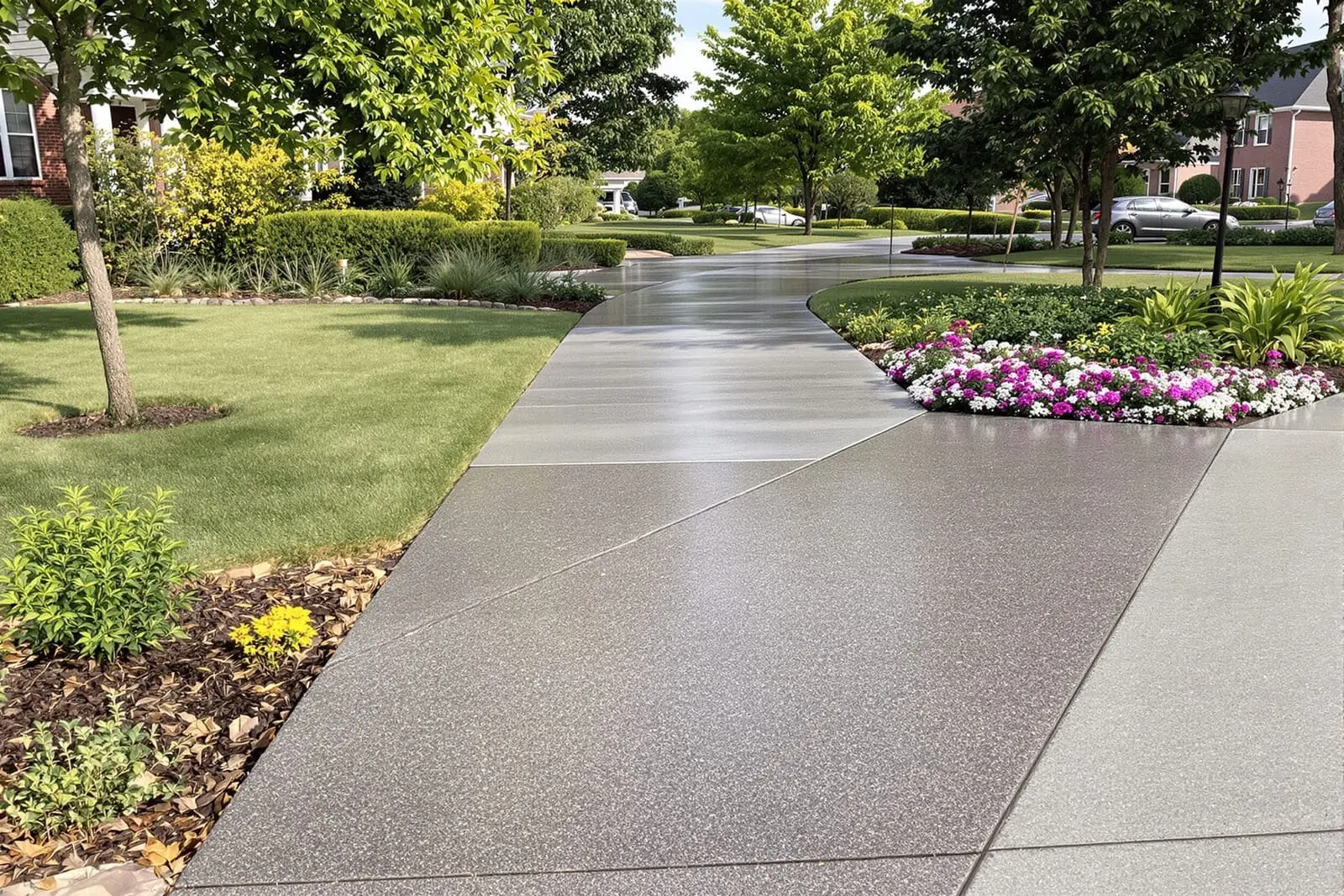
Improve access around your home with professional concrete walkway installation in Cincinnati, OH. We pour new sidewalks, garden paths, and entry walkways tailored to your landscape. Our team grades, forms, and finishes concrete paths that drain properly, look clean, and stay safe under everyday foot traffic.
Primetime Concrete Cincinnati provides professional concrete walkway installation throughout Cincinnati, OH and the surrounding area. Our licensed, insured crew delivers safe, clean, on-time work with a free estimate before anything begins. Call (513) 586-6699 or request your free quote.
Concrete walkway installation for Cincinnati homes and businesses
Primetime Concrete Cincinnati installs and repairs concrete walkways and sidewalks designed for the way people actually move around your property. We focus on safe foot traffic, clean drainage, and finishes that match the age and style of your home or building, whether you are in Hyde Park with a 1920s brick house or in a newer subdivision in Mason.
Every concrete walkway installation starts with how the space is used. We look at how many people use the path, winter shoveling routes, trash can access, delivery paths, and accessibility for strollers or wheelchairs. From that, we determine the walkway width, layout, and the slab thickness and reinforcement needed for long‑term performance in Cincinnati’s freeze and thaw cycles.
Our crew is familiar with local conditions: older neighborhoods with tree‑root heave and narrow side yards, hillside lots in Mt. Adams, and flat but poorly drained clay soils in much of Hamilton County. We design your walkway or sidewalk with these realities in mind, so you are not paying for a nice surface that will crack or tilt after a couple of winters.
How we plan and design your concrete walkway or sidewalk
A quality concrete walkway installation starts long before the concrete truck shows up. Primetime Concrete Cincinnati begins with an on‑site visit where we walk the entire route with you. We note door thresholds, steps, property lines, low spots in the yard, existing downspouts, and city sidewalk tie‑in points if the path connects to the public walk.
We sketch layout options that respect setback requirements and existing utilities. Straight runs work well along driveways or side yards. Gentle curves can soften the look in front yards and help avoid mature trees or roots, which is a common challenge in older Cincinnati streets with established canopies.
We also discuss thickness and reinforcement. For standard residential walkways that carry only foot traffic, we typically pour 4 inches thick with fiber reinforcement or wire mesh. If you expect cart, motorcycle, or light equipment traffic, we can increase the thickness to 5 inches and upgrade the reinforcement. These decisions are made in advance, so you understand exactly what is going into your project and why.
Step‑by‑step: how Primetime Concrete Cincinnati installs your walkway
Once the design is set, we handle the entire concrete walkway installation process in a systematic way so you get consistent results.
1. Layout and excavation: We mark the path edges with paint or string and verify slopes with a level. Most walkways are excavated 6 to 8 inches below final grade to allow for base stone and slab thickness. In many Cincinnati yards, we encounter heavy clay, so we remove soft or organic material until we reach solid subgrade.
2. Base preparation: We install compacted crushed stone, typically Number 57 or similar, to a depth of 3 to 4 inches. This base is compacted in lifts with a plate compactor to reduce future settling and to help manage water under the slab.
3. Forms and reinforcement: We set straight or flexible forms to create your layout and establish the final elevation and cross‑slope for drainage. We then place wire mesh, rebar, or fiber reinforcement, depending on the design. For public sidewalk replacements, we match city specifications for thickness and reinforcement when required.
4. Concrete placement: We pour ready‑mix concrete with an appropriate strength, commonly 4,000 psi for walkways, and air entrainment suited to Cincinnati’s freeze and thaw conditions. We place and screed the concrete to a uniform elevation, then float it to bring up paste and embed the aggregate.
5. Control joints and finishing: We install control joints at appropriate spacing, usually every 4 to 5 feet for standard width walks, to guide inevitable shrinkage cracking. Then we apply your chosen finish, most often a broom finish for traction during icy months.
6. Curing and cleanup: We apply curing methods that fit the season, such as curing compound or wet curing, and remove forms at the right time. We also backfill along the edges and can arrange for topsoil and seed so the walkway ties cleanly into your lawn.
Finish, color, and style options for Cincinnati walkways
Walkways and sidewalks do not have to be plain gray unless you want them to be. Primetime Concrete Cincinnati offers a range of finishes that balance safety, durability, and curb appeal.
The most common choice is a standard broom finish. It provides a lightly textured surface that gives better grip when wet or icy, which is important during Cincinnati winters. For front entries or garden paths where looks matter more, we can use exposed aggregate, where the top layer of cement paste is washed away to reveal the decorative stone in the mix. This pairs especially well with stone or brick facades in neighborhoods like Mt. Lookout, Clifton, and Wyoming.
We also install stamped concrete walkways that mimic brick, slate, or flagstone. For these, we are careful with pattern layout so the “stones” do not fall at awkward points like door thresholds or turns. Color options include integral color mixed into the concrete, or color hardener and release agents for more variation. We discuss slip resistance up front, since decorative finishes still need to be safe to walk on in rain and snow.
Edges can be plain, beveled, or decorative, and we can include border bands or contrasting bands at steps and landings to help with visibility. All of these options are priced clearly so you know how each upgrade affects your total cost.
Local conditions that affect cost and long‑term performance
Concrete walkway installation pricing depends on more than square footage. Primetime Concrete Cincinnati looks at site access, soil conditions, elevation changes, and required thickness to price your project accurately.
Poor access, such as narrow side yards in older Cincinnati neighborhoods or steep backyards along the hills, can require more labor and smaller equipment, which increases cost. Unstable or saturated soils may need more excavation and additional base stone. If your walkway connects to or replaces part of a city sidewalk, we also account for any local standards that dictate thickness or doweling into existing slabs.
Long‑term performance is strongly tied to drainage and freeze and thaw resistance. Cincinnati’s clay soils hold water, which can cause slabs to move or crack when temperatures drop. We address this with proper base preparation, adequate cross‑slope so water runs off the walk, and placement of joints at the right locations and depths.
We are transparent about these factors during your estimate. Instead of quoting a low price that ignores needed base work or reinforcement, we show you where the money goes and how it protects you from early cracking, heaving, or spalling.
Common Cincinnati walkway issues and how we fix them
Many of our projects at Primetime Concrete Cincinnati involve repairing or replacing existing walkways and sidewalks that have failed. We see a consistent set of problems across the region and have specific solutions for each.
Heaved or settled slabs: Often caused by tree roots or poor base preparation, these create trip hazards. Depending on the severity, we may recommend slab replacement, root barrier installation, or localized removal and repour. For public sidewalk panels that are out of compliance, we can replace only the affected sections to match city requirements.
Random cracking: Some hairline cracking is normal, but wide or offset cracks usually mean missing control joints, weak subgrade, or thin concrete. When possible, we sawcut and replace individual panels instead of tearing out the entire walk, which helps control cost.
Surface spalling and scaling: This is common where deicing salts are used and the original concrete mix or curing was not suited to Cincinnati winters. In mild cases we can resurface with a bonded overlay. In more advanced cases we recommend a full replacement with air‑entrained concrete and proper curing.
Drainage problems: Walks that slope toward the house or trap water against foundations can lead to moisture issues. We correct this by regrading the path, adjusting elevations at steps and landings, or incorporating drains along the edge where needed.
What to expect when you hire Primetime Concrete Cincinnati
When you schedule a concrete walkway installation with Primetime Concrete Cincinnati, we outline the timeline and what you need to plan for.
Most residential walkway projects take 1 to 3 working days for demolition, base prep, and pouring, plus curing time. Under typical Cincinnati summer conditions, you can usually walk on the new surface after 24 to 48 hours and move heavier items after about a week. In cooler months, we adjust schedules and curing methods to protect the concrete.
We handle permitting guidance where needed, especially if we are working on or near the public sidewalk. We coordinate with you on access so you can still enter and leave your home during the project, using temporary paths or staggering work sections when necessary.
Before we finish, we review joint locations, drainage, and any special care instructions with you. We can also discuss sealing options once the concrete has cured sufficiently, which helps resist staining and surface wear.
Our goal is that when we leave, you understand exactly how your new walkway or sidewalk was built, why it will stand up to Cincinnati weather, and how to maintain it so it keeps performing for years.
“
Professional concrete walkways & sidewalks, done right the first time, quality materials, honest pricing, and results that last.
Primetime Concrete Cincinnati
Concrete Walkways & Sidewalks Across Our Service Area